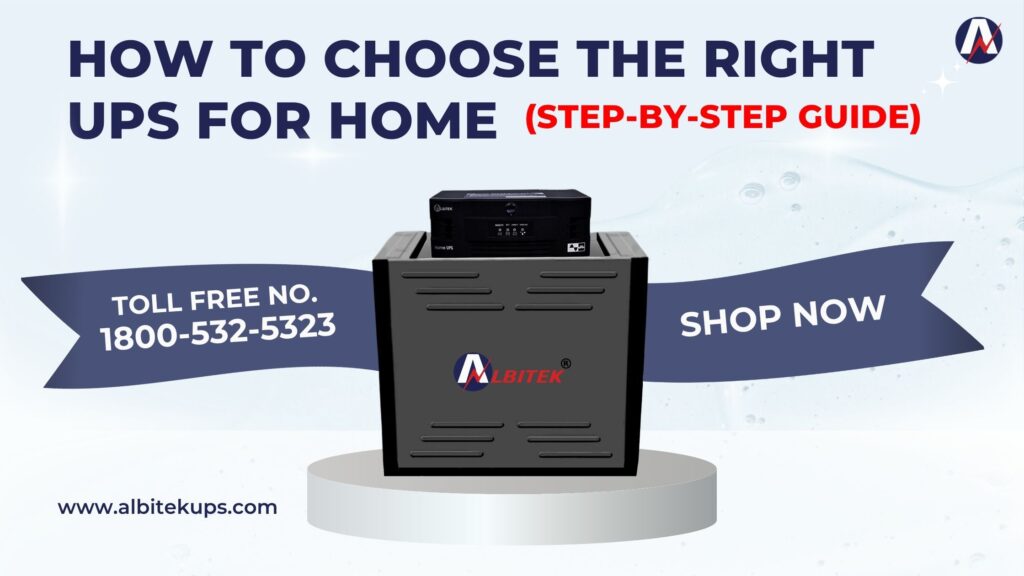
How to Choose the Right UPS for Home (Step-by-Step Guide)
Introduction
Power cuts are still a common problem in many homes across India. Whether you’re working from home, attending online classes, or simply watching TV, an unexpected outage can disrupt everything. That’s where a UPS (Uninterruptible Power Supply) becomes essential. But choosing the right UPS for home can be confusing if you don’t know what to look for. In this guide, we’ll explain everything step by step so you can choose the perfect UPS for your needs.
What is a UPS and Why Do You Need It?
A UPS is a device that provides instant backup power when electricity fails. Unlike inverters, it supplies power without delay, making it ideal for sensitive electronics like computers, WiFi routers, TVs, and home office equipment.
Step 1: Calculate Your Power Requirement
Before buying a UPS for home, you must calculate the total load you want to run during a power cut.
Example:
| Appliance | Power (Watts) |
|---|---|
| Fan | 70W |
| LED TV | 100W |
| WiFi | 20W |
| Lights | 60W |
Total Load = 250 Watts (approx.)
Formula:
VA = Watts / Power Factor (0.8 approx.)
250 / 0.8 = 312 VA
You should choose at least a 600 VA UPS for safety and future expansion.
Step 2: Choose the Right Battery Capacity ups for home
The battery determines how long your backup will last. Common battery types include flat plate batteries (budget-friendly), tubular batteries (longer life and recommended), and lithium-ion batteries (modern and compact). For longer backup, always choose a higher Ah (Ampere-hour) battery.
Step 3: Decide Backup Time
You need to decide how long you want the UPS to run during a power cut.
- 1 to 2 hours requires a basic battery
- 3 to 5 hours requires medium capacity
- 6 hours or more requires high capacity
Step 4: Understand UPS Types
Offline UPS is suitable for basic home usage, comes at a lower cost, and works well for most households. Online UPS provides zero switching delay and is ideal for sensitive equipment like computers and servers, but it is more expensive. For most homes, an offline UPS is sufficient.
Step 5: Consider Your Home Size
For a 1BHK home, a 600–800 VA UPS is usually enough.
For a 2BHK home, you may need 800–1200 VA.
For a 3BHK home, a 1200–2000 VA UPS is recommended.
Step 6: Look for Safety Features
A good UPS should include overload protection, short circuit protection, battery deep discharge protection, and smart charging features.
Step 7: Choose a Reliable Brand
Always choose a trusted brand Albitek UPS that offers good warranty, reliable service support, and efficient performance. Albitek UPS is a dependable option that provides stable backup, long battery life, and reliable performance for both home and office use.
Common Mistakes to Avoid
Avoid buying a low-capacity UPS for home, ignoring battery size, not checking backup time, and choosing low-quality or unbranded products.
Pro Tips
Keep at least 20–30 percent extra capacity for future needs.
Install the UPS in a well-ventilated area.
Perform regular maintenance to increase battery life.
Conclusion
Choosing the right UPS for home becomes easy when you understand your power needs, battery capacity, and required backup time. A well-selected UPS ensures uninterrupted comfort and productivity during power cuts.Investing in a reliable UPS system will give you peace of mind and consistent power support whenever you need it.
1. What size UPS is best for home use?
The ideal UPS size depends on your total power load. For most homes, an 800–1200 VA UPS is sufficient to run basic appliances like fans, lights, TV, and WiFi.
2. How do I calculate the right UPS capacity?
You can calculate UPS capacity by adding the wattage of all appliances and dividing by the power factor (usually 0.8). This gives you the required VA rating.
3. How long can a UPS provide backup at home?
Backup time depends on the battery capacity and load. A standard home UPS can provide backup ranging from 1 to 5 hours, depending on usage.
4. Which battery is best for a home UPS?
Tubular batteries are considered the best for home UPS systems because they offer longer life, better performance, and require less maintenance compared to flat plate batteries.
5. Can a UPS run all home appliances?
No, a UPS is not designed for heavy appliances like air conditioners, refrigerators, or geysers. It is best suited for light loads such as fans, lights, TV, and computers.